;

Actuator wire

Actuator wire leverages shape memory Nitinol to deliver reliable, repeatable motion in compact spaces. The wire stretches under load at room temperature, then contracts back to its original length when heated, performing work. As it cools, it resets and is ready to cycle again—providing an efficient, lightweight actuation solution for complex devices.

Talk with a technical expert

Understanding the benefits

Nitinol's unique properties allow it to perform a surprising amount of work for its size. This means that actuator wire is smaller, lighter, quieter, and can be longer-lasting than more traditional actuators.

Key terms

Designing with actuator wire comes with some specific terminology. We've broken down a few of the most important terms below so you can share a common language when you speak with one of our engineers.

  • Ais the austenite start temperature, and is also referred to as the "actuation start" temperature in actuator applications. This is the temperature at which the material transforms and performs work under a given load.
  • Application stress is a result of the amount of load or bias force imposed on the actuator wire in application. Optimal stress for product life is between 100 MPa and 150 MPa. The amount of stress applied will also influence actuation temperatures.
  • Fatigue life is determined using thermo-mechanical cycles, or the number of times the material can be thermally cycled between phases while under a certain applied stress.
  • Hysteresis width is the difference between the austenitic and martensitic transformation temperatures. This temperature delta corresponds to how quickly the actuator will reset after being heated for actuation.

Typical end uses

Actuator wire is often used in industries with small spaces and where lightweight devices are required, such as:

  • Active textiles
  • Aerospace
  • Automotive
  • Consumer electronics


Talk with a technical expert

Design specifications

Actuator wire is available on a spool in various size ranges and actuation temperatures. Use our actuator calculator and the chart below to explore possibilities.

There are a number of considerations when using actuator wire in your applications. You can use this information to guide your conversation with our Engineering team.

Size ranges and operating parameters

Size range
As

Recommended
application
stress

Hysteresis width
0.0762 mm to 0.5842 mm
[0.003 in to 0.023 in]
70 °C to 95 °C
[158 °F to 203 °F]
100 MPa to 150 MPa
[14.5 ksi to 21.75 ksi]
30 ± 5 °C
[54 ± 9 °F]


As and hysteresis width based on 150 MPa application stress. Recommended application stress values are for maximized stroke performance and fatigue life. Application stresses outside of this range can also be used depending on the design requirements of the actuator. Since actuators are preconditioned wires engineered for specific uses, not all of the outputs generated by this calculator are practically feasible.

If you are interested in something outside what seems possible, please contact your Sales Representative to discuss how we can still support your unique needs.

Talk with a technical expert

Product forms and capabilities

Actuator wire is just the start, additional in-house processing and testing capabilities are available to support your innovations. Our Engineering team will support you in determining which options would be the best for your application. Reach out to your Sales Representative for more information.

Mechanical assembly

Consists of crimps, fittings, and specialized parts

Thermo-mechanical testing

For shape memory and superelastic performance

Technical information

If you want to better understand how actuator wire works and its characteristics, download our Nitinol Actuator Wire Technical Information Sheet.

We have a library of Nitinol actuator wire data sheets to help guide your selection of the right diameter wire for your application. The data sheets contain specific electrical and actuation characteristics, including heating time, cooling time, the amount of stroke, and the amount of current to supply to the wire.

Download actuator data sheets

If your application requirements fall outside our performance specifications, fill out the form below to contact our technical experts and discuss the possibilities for meeting your material needs. 

Unable to load the form? Click the button below:

Start the conversation


Actuator wire

Actuator wire leverages shape memory Nitinol to deliver reliable, repeatable motion in compact spaces. The wire stretches under load at room temperature, then contracts back to its original length when heated, performing work. As it cools, it resets and is ready to cycle again—providing an efficient, lightweight actuation solution for complex devices.

Talk with a technical expert

Understanding the benefits

Nitinol's unique properties allow it to perform a surprising amount of work for its size. This means that actuator wire is smaller, lighter, quieter, and can be longer-lasting than more traditional actuators.

Key terms

Designing with actuator wire comes with some specific terminology. We've broken down a few of the most important terms below so you can share a common language when you speak with one of our engineers.

  • Ais the austenite start temperature, and is also referred to as the "actuation start" temperature in actuator applications. This is the temperature at which the material transforms and performs work under a given load.
  • Application stress is a result of the amount of load or bias force imposed on the actuator wire in application. Optimal stress for product life is between 100 MPa and 150 MPa. The amount of stress applied will also influence actuation temperatures.
  • Fatigue life is determined using thermo-mechanical cycles, or the number of times the material can be thermally cycled between phases while under a certain applied stress.
  • Hysteresis width is the difference between the austenitic and martensitic transformation temperatures. This temperature delta corresponds to how quickly the actuator will reset after being heated for actuation.

Typical end uses

Actuator wire is often used in industries with small spaces and where lightweight devices are required, such as:

  • Active textiles
  • Aerospace
  • Automotive
  • Consumer electronics


Talk with a technical expert

Design specifications

Actuator wire is available on a spool in various size ranges and actuation temperatures. Use our actuator calculator and the chart below to explore possibilities.

There are a number of considerations when using actuator wire in your applications. You can use this information to guide your conversation with our Engineering team.

Size ranges and operating parameters

Size range
As

Recommended
application
stress

Hysteresis width
0.0762 mm to 0.5842 mm
[0.003 in to 0.023 in]
70 °C to 95 °C
[158 °F to 203 °F]
100 MPa to 150 MPa
[14.5 ksi to 21.75 ksi]
30 ± 5 °C
[54 ± 9 °F]


As and hysteresis width based on 150 MPa application stress. Recommended application stress values are for maximized stroke performance and fatigue life. Application stresses outside of this range can also be used depending on the design requirements of the actuator. Since actuators are preconditioned wires engineered for specific uses, not all of the outputs generated by this calculator are practically feasible.

If you are interested in something outside what seems possible, please contact your Sales Representative to discuss how we can still support your unique needs.

Talk with a technical expert

Product forms and capabilities

Actuator wire is just the start, additional in-house processing and testing capabilities are available to support your innovations. Our Engineering team will support you in determining which options would be the best for your application. Reach out to your Sales Representative for more information.

Mechanical assembly

Consists of crimps, fittings, and specialized parts

Thermo-mechanical testing

For shape memory and superelastic performance

Technical information

If you want to better understand how actuator wire works and its characteristics, download our Nitinol Actuator Wire Technical Information Sheet.
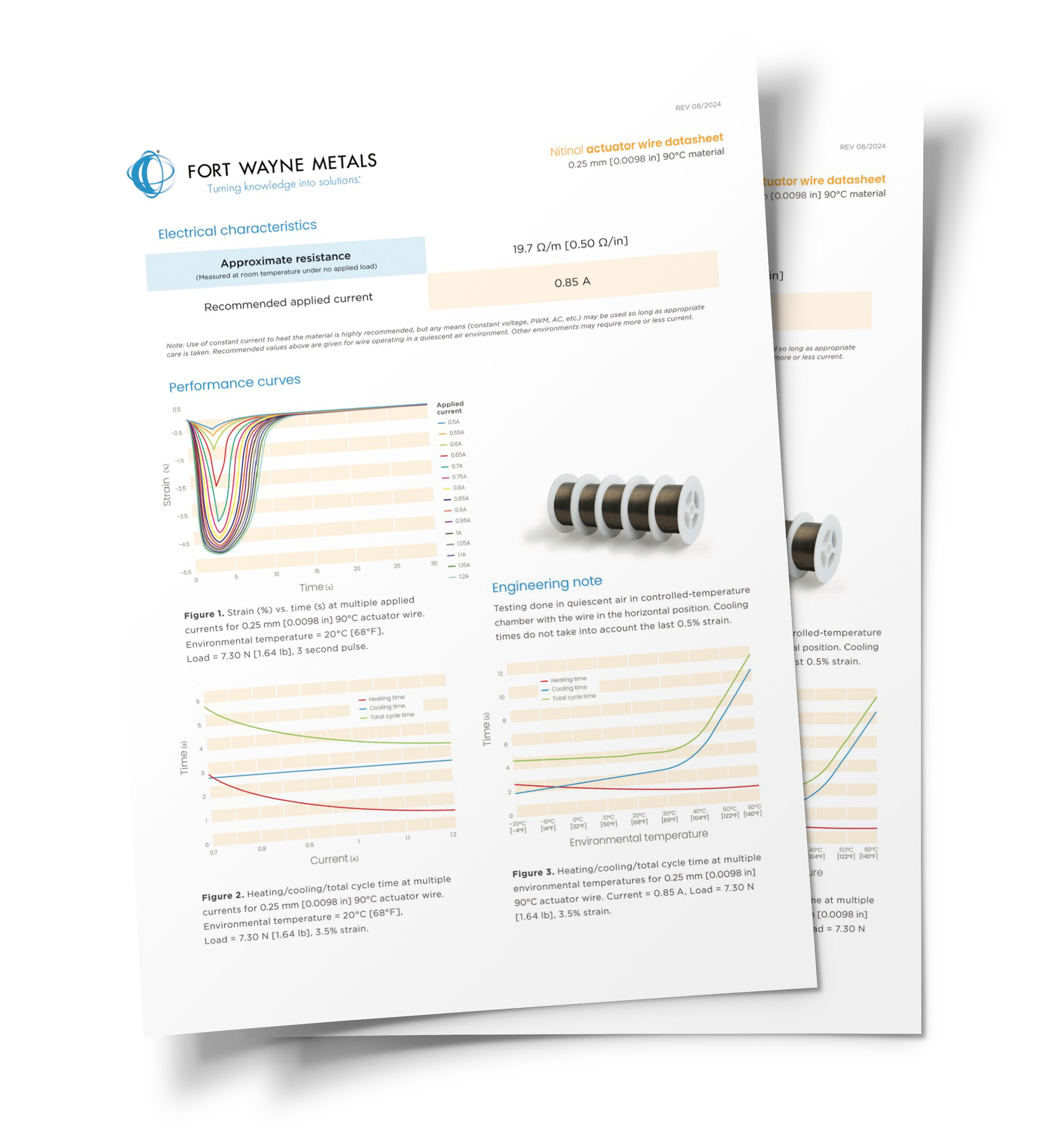
We have a library of Nitinol actuator wire data sheets to help guide your selection of the right diameter wire for your application. The data sheets contain specific electrical and actuation characteristics, including heating time, cooling time, the amount of stroke, and the amount of current to supply to the wire.

Download actuator data sheets

If your application requirements fall outside our performance specifications, fill out the form below to contact our technical experts and discuss the possibilities for meeting your material needs. 

Unable to load the form? Click the button below:
Start the conversation